
River of Refuge newsletter, February 2026
River of Refuge Celebrates Record Number of Graduating Families
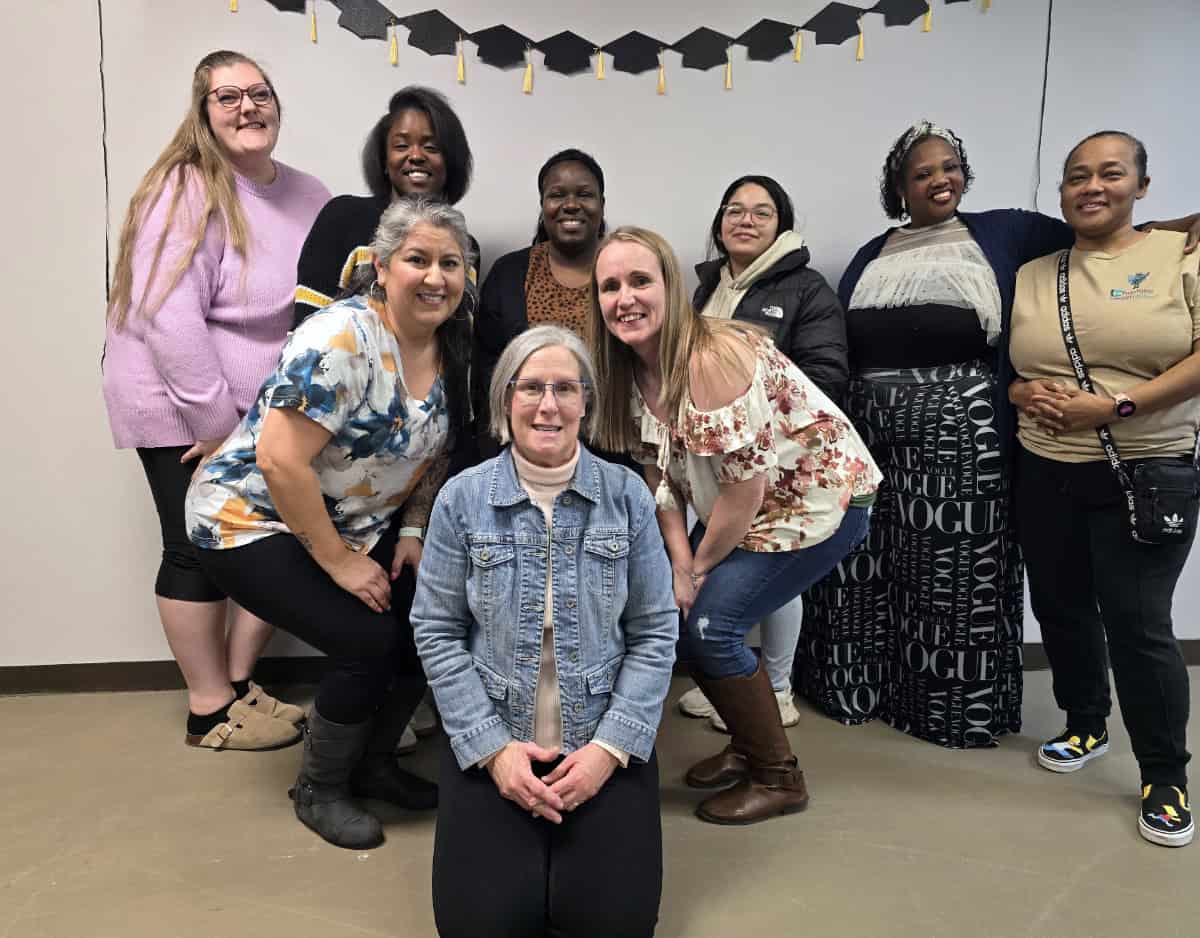
Some of the 2025 graduates stand behind River of Refuge executive director, Pam Seymour (kneeling), who is flanked by staff members Cathy DeCamp (left), program manager, and Michelle Baker (right), senior case manager, following the Feb. 4, 2026, graduation ceremony.
The calendar had already turned, but on one evening earlier this month, River of Refuge staff and families celebrated 2025.
The Feb. 4 gathering marked the graduation for 10 families that completed the program last year.
That group was among 15 families that graduated last year, the largest number since River of Refuge opened its doors a decade ago, providing a springboard to a good start to this year. (See next story.)
A 2022 expansion that added eight apartments helped drive the banner year, but so too did improved screening that identified parents well-suited to completing the program.
The diverse group of finishers feted this month included one two-child couple, Jordan and Michael, and several single moms, including one with seven children, who Senior Case Manager Michelle Baker noted worked long overnight shifts to achieve financial stability.
“She never had the excuse of, ‘Oh, I have seven kids, I can’t do this, I can’t do that,’” Baker said. “She pushed hard the whole time she was here and made it happen for her and her children.” The audience cheered.
Baker highlighted Michael and Jordan for often ringleading impromptu gatherings of the families.
Jordan was among the graduates to speak. Like many of her fellow graduates, she noted the friendships her family developed with the other residents as they worked the program.
“Everybody who has been here, their road led here for a reason. You never imagine the amount of help you can get from people until you actually ask,” Jordan said. “It’s hard out there. We’re just really grateful that we were able to be here and be a part of the graduates.”
Some of the other graduate comments included:
- Ashley: “I don’t want to say they watched my every move, but that’s the way it was,” she said of staff that bird-dogged her spending. “But I didn’t mind it, though. I thought it was very beneficial.” She fought back tears when discussing the challenges of working the program as a single mother, noting the welcoming environment of River of Refuge.
- Michelle: Noted the program’s positive impact on her 15-year-old autistic son, who enjoyed the Teen Talk sessions with other kids. She said the program helped her stop beating herself up over perceived shortcomings. “And I got a little too comfortable, that I didn’t want to leave — I ain’t going to lie,” she said. But Michelle knew she had to leave “so we could make space for other people so they can do what they need to do.”
- Lorenza: “I knew I was in the right place when we were doing intake, and Michelle was showing me to our apartment, and on the door it said ‘welcome,’ and it had all our names on it,” she said. “I’m kind of corny, but that made my day, because it’s like ‘OK, here’s a chance at a new start.’” She urged the current families in the audience to take advantage of the mental health counseling as she did.
The single-mindedness with which the graduates went about working the program impressed current resident Johnny. He wondered how the graduates handled the rules governing visitors, something he was used to managing himself.
Executive Director Pam Seymour echoed the sentiments of the graduates who told Johnny that living at River of Refuge was a good time to work on themselves and reevaluate relationships.
“The biggest takeaway is just keep pushing ahead and that the sacrifices that you may need to make here, as some of these families have said, it changed their life,” Seymour said, “and someone who you thought was your friend was really not, because if they were truly your friend or a good person in your family, then they would be supporting you, and not after you to do things you are not supposed to be doing.”
Payment of County Money Part of Good Start to 2026
It wasn’t exactly a windfall, because River of Refuge had expected the money last year, but the fact that River of Refuge recently received $152,000 in funding from Jackson County was a big win nevertheless.
In the first two months of this year, River of Refuge has received $63,000 in outside agency funding, $53,000 in leftover COVID-19 relief money, and $36,000 from the county’s Housing Resources Commission.
Executive Director Pam Seymour credited interim Jackson County Executive Phil LeVota for expediting payment of the money. Funding had stalled while the previous executive and the Legislature were at loggerheads.
“That is a big deal to me,” Seymour said, “having now someone making decisions and understanding the predicaments this last year put nonprofits in.”
She also credited county official James Tindall Sr. for helping break the logjam on the housing funding.
Within the past several weeks, Seymour said the county has convened check-signing meetings where nonprofit executives received checks in a matter of minutes.
Even under the best-case scenario, it can take weeks for the county to approve allocations. The funding approved recently is also notable, Seymour said, because it was provided in full rather than being distributed as a reimbursement for invoiced expenses.
The one-time COVID-19 funding is welcome income that will help pay for a variety of expenses, including staff salaries, communications, utilities, pest control, snow removal, and grass mowing.
Seymour said the county funding was not the only good news to start the year.
She noted that 4 families have already graduated from the program in 2026.
Some of that is simply a function of the calendar; the families stayed a normal amount of time but entered the program in the second half of last year. Seymour said it is still noteworthy to have this many graduates so early in the year.
FROM THE DIRECTOR
Regular readers of our newsletter will remember that a posthumous donation in June 2024 made River of Refuge the proud owner of five laying hens. That fall, we upgraded the hens’ living quarters.
Fast forward to today, and we now have seven hens. And I, as the “chicken tender,” have thoughts of additional chickens dancing in my head with spring just around the corner.
The flock thankfully made it through the recent cold spell just fine — our insulated coop and a lot of wood shavings keep them snug.
Our current headcount comes despite saying goodbye to Hazel, Ethel, and one adventurous Cinnamon Queen, who didn’t beat the auto door curfew and encountered a hungry raccoon.
Speaking of chicken death, what do you do? Do you build a casket and hold a little burial ceremony? Or, do you simply toss it in the trash?
I struggled with the first death.
I teetered between the trash and a full-blown funeral service. My husband is very patient and understanding of my attachments to animals, so he didn’t offer any opinions.
I finally realized after a few hours that, although they are pets to us, chickens have a lifespan, and even if healthy and in a critter-proof home, they don’t live that long. If I went the funeral route, we’d have little headstones dotting the property for years.
However, to avoid another premature death at the hands of a critter, we have pointed our security cameras at the coop and run. I can monitor the cameras from home, and thankfully, if somebody gets trapped outside again, I live close enough to drive over and let them in within a few minutes.
(As an aside, it has been amazing to see the menagerie of nocturnal wildlife that wanders around our campus.)
Of our seven hens, we are seeing only three to four eggs per day. I’m not sure if there is a rotation happening, or if it’s the same three or four hens doing their job.
I’m already watching for 6- to 12-month-old chickens to become available.
Why not chicks, you might say? They are just too much work. You need specific equipment and a lot of time to keep them alive.
I need a hen that’s ready to lay upon arrival and that I don’t have to worry too much about being mauled by other hens after the initial quarantine and introduction.
This time around, I’d like to try a breed that produces a colored egg, rather than the standard white, beige, and light brown.
I’ve heard that the Easter Egger Hen might satisfy our need for color — so I will start there.
Until Next Time,
Pamela Seymour, Executive Director